






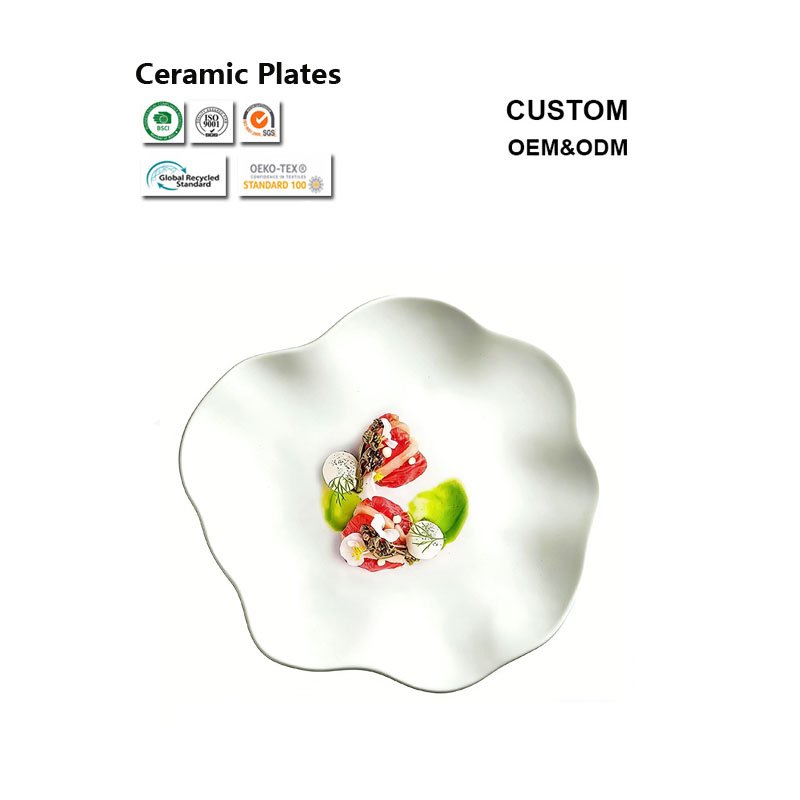


Wall thickness on a 27 cm plate runs 6.2 mm at the rim and 4.8 mm at the well. A rim that thins to 5.4 mm at the 12 o’clock point loses roughly 18% of its impact resistance against a 1.1 m dish-room drop. That single tolerance band decides whether a custom logo plate survives service or returns as breakage.
Why Rim Thickness Drives Breakage Before Decoration Does
A plate fails at the point where cutlery strikes, the stack compresses, and the dishwasher rack pinches — all rim events. A decal under glaze at 1180–1250°C fuses into the body; it wears only if the glaze beneath it chips. Wall thickness at the rim determines whether the glaze chips first. On a 23 cm plate, a 0.4 mm wall variation moves edge-chip rate from about 1.3% to 3.1% across a 5,000-piece run. Buyers approving a logo should approve a rim thickness band with it.

Reading a Wall Thickness Band on a Fired Plate
Thickness is measured after firing, not on the green body, because stoneware shrinks 9–11% and porcelain 12–14% between pressing and the kiln exit. A spec written on the mould means nothing to the buyer. Ask for a fired measurement at 4 points: rim edge, rim shoulder, well centre, foot ring. On the 20 cm and 28 cm round bodies, the rim shoulder should read 5.6–6.4 mm; the foot ring 6.0–7.0 mm. Anything below 5.2 mm at the shoulder is a breakage risk in stacked dish-room handling.
Rim Tolerance and the Weight Figure That Follows It
Rim tolerance and piece weight move together. A 27 cm porcelain plate at 640 g with a rim band of ±0.3 mm holds a stack height within 2 mm over 24 pieces. Widen the band to ±0.6 mm and the same stack drifts 6–8 mm, which changes carton fill and the 20 kg gross weight on the packing list. Weight drift of 40 g below the approved sample is the warning sign: it usually means a thinner rim, not a lighter body. Distributors comparing landed cost per 40HQ — about 1,240 cartons — should treat weight as the cheap proxy for wall thickness.
Square Bodies Carry a Tighter Corner Tolerance
Square plates at 20, 23, 27 and 28 cm concentrate stress at the corner radius. The corner wall needs 0.5–0.8 mm more thickness than the straight edge, and the radius tolerance should be held to ±0.4 mm so the plate seats flat. A square body that warps 1.2 mm across the diagonal will rock on a granite surface and chip at the corner within weeks. Sampling includes a warpage measurement on granite for this reason; request the diagonal figure in writing before approving a square logo plate.
What the Sample Must Prove Before 1,000 Pieces Run
- Fired rim thickness at 4 points, with the measurement method named
- Piece weight against the approved standard, ±20 g
- Warpage on granite, under 1.0 mm for round, 1.2 mm for square
- Stack height over 24 pieces, within 2 mm
- Glaze thickness at the rim, 0.25–0.35 mm, so the decal sits on sound glaze
Sampling takes 10–12 days. MOQ is 1,000 pcs per size and finish, mixed sizes loading by carton count at 24 pcs per carton, 0.045 cbm, 20 kg gross.
Where Underside Stamping Changes the Breakage Equation
Underside stamping starts at 1,000 pcs and costs less than a decal at volume because it cannot wear off — but it also removes a firing pass, and that pass is where a thin rim would show distortion. A stamped plate still needs the same rim band. Keep plates, bowls at 12, 15 and 18 cm, and mugs from one glaze family on a single colour standard so a mixed programme ships on one thickness spec rather than three.

Holding the Thickness Standard Across Repeat Orders
The approved standard is held for 24 months, so a repeat order matches the first shipment in shade, capacity and weight. Each lot ships with a packing list stating carton dimensions and gross weight, and food contact reports for FDA and EU files are issued per lot. Contract breakage allowance is 2%, replaced on the next order when exceeded — a figure that only holds if the rim band was specified at sampling. Lead time is 30–35 days after sample approval. Reference price is 4.80 USD per unit at the quoted volume.
Size and colour options sit on the ceramic mug category page, and the firing and glazing steps behind these numbers are described in the manufacturing process walkthrough.
Buyers comparing formats usually put Ceramic Serving Plates – Factory Direct Tableware for Restaurants in the same sample box, since both run on the same mould base.