






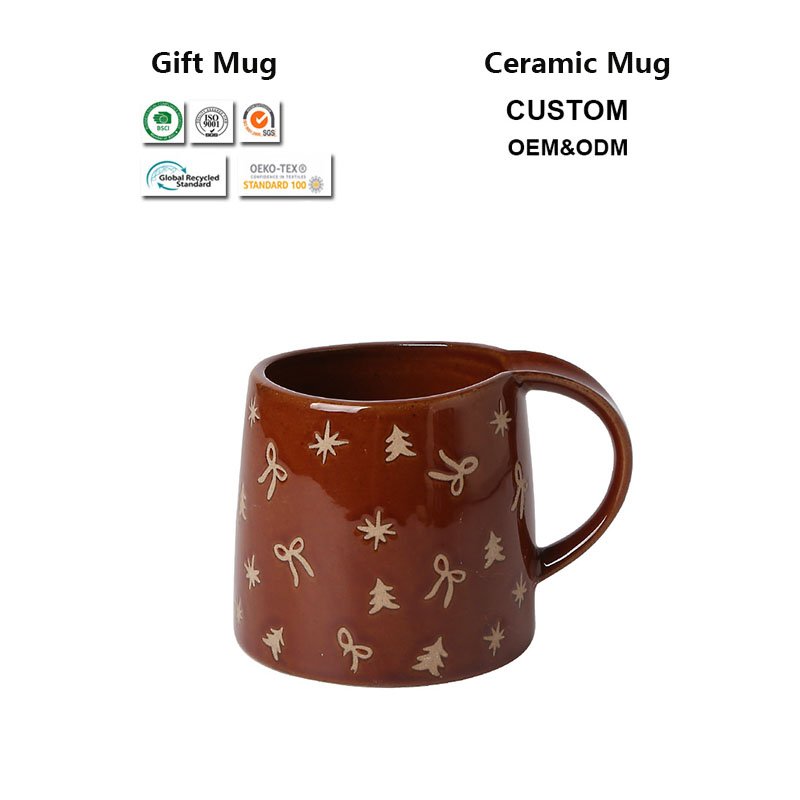
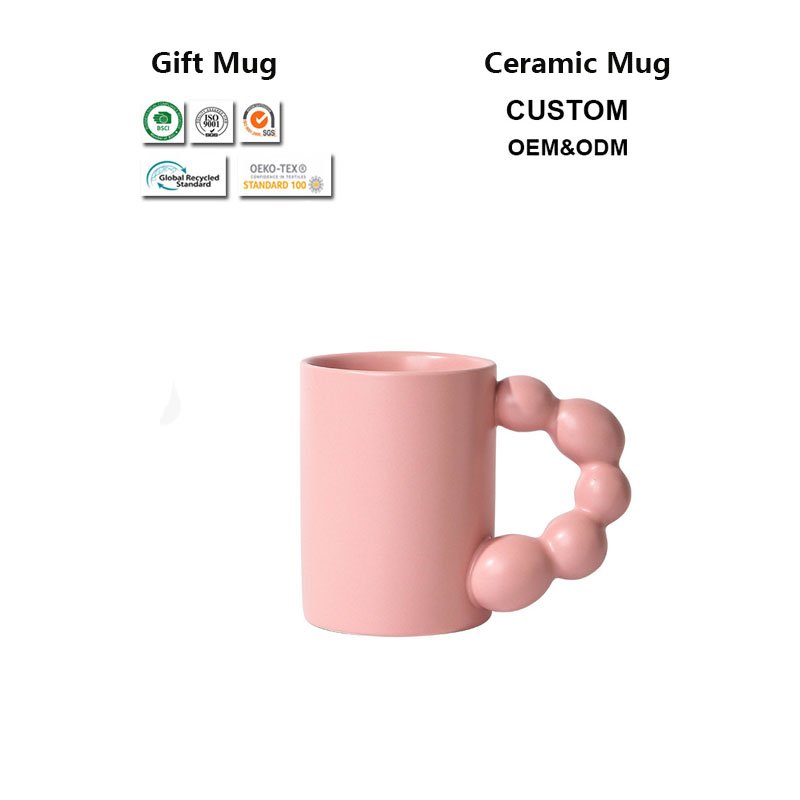

Private label orders start at 500 pieces per colour and capacity, and Pantone matching moves that floor to 1,000. Sampling runs 10–15 days, with the sample fee credited against the first production order. Between 500 and 5,000 pieces, the mug itself barely changes — what changes is setup, tooling and how the line handles artwork.
What 500 pieces actually buys in setup and tooling
At 500 pcs, one glaze run and one print setup are shared across the whole lot. Box artwork, the barcode panel and a printed insert card are included at this floor, so the cost driver is the setup rather than the ceramic. Handle opening can be set between 25 and 32 mm, and base diameter adjusted to an existing rack pitch before tooling. Each unit is printed individually, which is why artwork approval — not the press — is where personalisation breaks. A 500-piece run leaves little room for a second print pass, so the artwork file has to be right the first time.

Sampling rounds: what gets signed off before tooling
Sampling takes 10–15 days and typically runs in rounds. Round one confirms profile: 8–20 oz capacity range, with 11 oz and 12 oz as the standard commercial sizes, wall at 4–7 mm, rolled rim, and stoneware fired at 1180–1220°C with water absorption below 3%. Round two confirms print position and colour against the approved standard. Handle pull is tested to 8 kg minimum, three pulls per unit. Sign-off on that standard is held for 24 months, so a repeat order does not restart the artwork conversation.
Where the 500-piece order stops and 5,000 begins
At 5,000 pieces, the same mug carries a different cost structure. Mixed capacities can load in one container by carton count, which avoids paying a separate glaze setup per colour — a saving that only appears at volume. Retail-ready packing adds a printed sleeve and barcode panel at roughly 0.12 USD per unit at 1,000 pcs, and that figure holds across larger lots. Cartons run 36 or 48 pcs at 0.03–0.04 cbm, quoted with dimensions and gross weight so the forwarder plans loading without re-measuring.
Rim chipping and what volume reveals about it
Rim chipping comes second only to artwork as a failure point. A sharp edge concentrates impact from a rack or a sink; a rolled rim spreads the load across a curve. At 500 pieces, a single chipped rim is a sample problem. At 5,000, it is a packing and handling pattern — which is why carton count and drop test results are quoted per lot rather than assumed.
Lead time and the 25–32 day window
Lead time runs 25–32 days after sample approval. The lower end suits a 500-piece single-colour run with artwork already approved; the upper end covers Pantone matching at 1,000 pcs and multi-capacity containers. Food contact reports for FDA and EU files are issued per lot, and every lot ships with a packing list stating carton dimensions and gross weight.
Planning a run that scales from 500 to 5,000
- Fix handle opening (25–32 mm) and base diameter before tooling, not after.
- Approve artwork in round two of sampling; a second print pass at 500 pcs is costly.
- Use 11 oz and 12 oz as the volume sizes; keep 8–20 oz for range fill.
- Confirm carton count (36 or 48 pcs) against container load before quoting freight.
- Hold the approved standard for 24 months to keep repeat orders off the sampling clock.

What changes in the quote between the two volumes
At 500 pcs, the quote is dominated by setup: glaze run, print setup, box artwork and insert card. At 5,000, setup is amortised and the variables shift to packing, sleeve application and container loading by carton count. The mug specification — 4–7 mm wall, rolled rim, 8 kg handle pull — stays fixed across both. What a buyer negotiates at 5,000 is not the ceramic but the handling around it.
Size and colour options sit on the ceramic mug category page, and the firing and glazing steps behind these numbers are described in the manufacturing process walkthrough.