






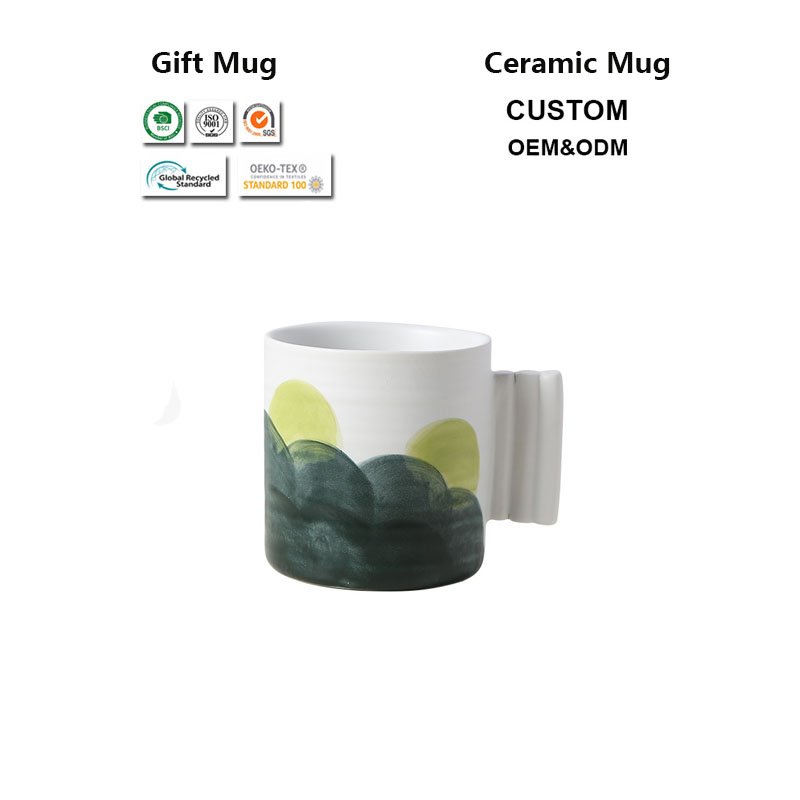


Modern ceramic coffee mugs from COMAIN are built around a 4–7 mm wall and a rolled rim, with stoneware fired at 1180–1220°C and water absorption held below 3%. Those figures set the baseline for how the glaze and decoration survive repeated dishwasher exposure. The durability story is not a single test; it is the interaction of body density, glaze fit, and decoration method across 100+ cycles.
Why Wall Thickness at 4–7 mm Governs Glaze Stress
A wall below 4 mm cools quickly after firing and concentrates thermal shock at the rim; above 7 mm the body retains heat unevenly and can pull the glaze in tension. This line holds the 4–7 mm band so the glaze and body contract at compatible rates. That compatibility is what keeps a dishwasher cycle from opening craze lines. Each production lot is checked for absorption below 3%, because a porous body absorbs moisture and steam pressure during drying can lift decoration at the rim.

Rolled Rim Geometry and Chip Resistance Through 200 Cycles
The rolled rim spreads impact across a curve rather than a sharp edge. In rack loading, rims contact wire tines at repeated angles; a rolled profile distributes that load and reduces the chance of a chip that exposes unglazed body. We pull-test handles to 8 kg minimum across three pulls per unit, and the same rim geometry is inspected after 200 dishwasher cycles for edge wear. Chipping at the rim is the first failure mode in commercial dishwashing, so the rim is where the durability budget is spent.
Decoration Methods Ranked by Dishwasher Survival
Not all decoration sits equally on a fired glaze. The line supports several methods, and their durability differs under detergent and heat:
- Esmalte subjacente decoration fired beneath the glaze layer; the decoration is protected by the glaze itself and holds colour across repeated cycles.
- No esmalte decoration fired into the glaze surface; good resistance, with slight colour shift possible after extended exposure.
- Sobre o esmalte decoration fired above the glaze; suitable for low-cycle use, less suited to daily commercial washing.
- Adesivo application; durability depends on firing temperature and is quoted per design.
Buyers specifying cafe or office use should match the decoration method to the expected cycle count, not to the sample appearance alone.
Detergent, Temperature and the 100-Cycle Reference
Commercial dishwashers run at higher temperatures and stronger detergent concentrations than domestic units. We reference 100 cycles as a working benchmark for glaze and decoration assessment, with 200 cycles used for rim and handle checks. Glaze crazing and decoration loss are recorded separately, because a mug can pass one and fail the other. Stoneware fired at 1180–1220°C with absorption below 3% gives the body the density needed to resist moisture uptake that accelerates decoration failure.
What Changes When You Specify a Different Glaze
Glaze chemistry affects fit against the body. A glaze that fits the 4–7 mm wall at one firing curve may craze if the curve shifts, so glaze changes are treated as a new approval, not a colour swap. Pantone matching starts at 1,000 pcs per colour and capacity; standard colours run from 500 pcs. Mixed capacities load in one container by carton count, which avoids a separate glaze setup per colour and keeps the approved glaze lot consistent across the shipment.
Sample Cycles, Lot Reports and the 24-Month Standard

Sampling takes 10–15 days and the sample cost is credited against the first production order. Each lot ships with a packing list stating carton dimensions and gross weight, and FDA and EU food contact reports are issued per lot. Cartons hold 36 or 48 pcs at 0.03–0.04 cbm. The approved standard is held for 24 months, so a repeat order matches the first shipment in shade, capacity and glaze behaviour. Lead time runs 25–32 days after sample approval, and private label starts at 500 pcs including box artwork, barcode panel and a printed insert card.
As opções de tamanho e cor estão na caneca de cerâmica página da categoria, e as etapas de queima e esmaltação por trás desses números são descritas em o passo a passo do processo de fabricação.
Os compradores que comparam formatos costumam levar em conta Vaso de cerâmica em estilo japonês – Vaso minimalista para plantas de interior e Vasos de cerâmica no atacado – Vasos de flores para decoração de interiores em grandes quantidades para hotéis na mesma caixa de amostras, já que ambas são produzidas na mesma base de molde.