





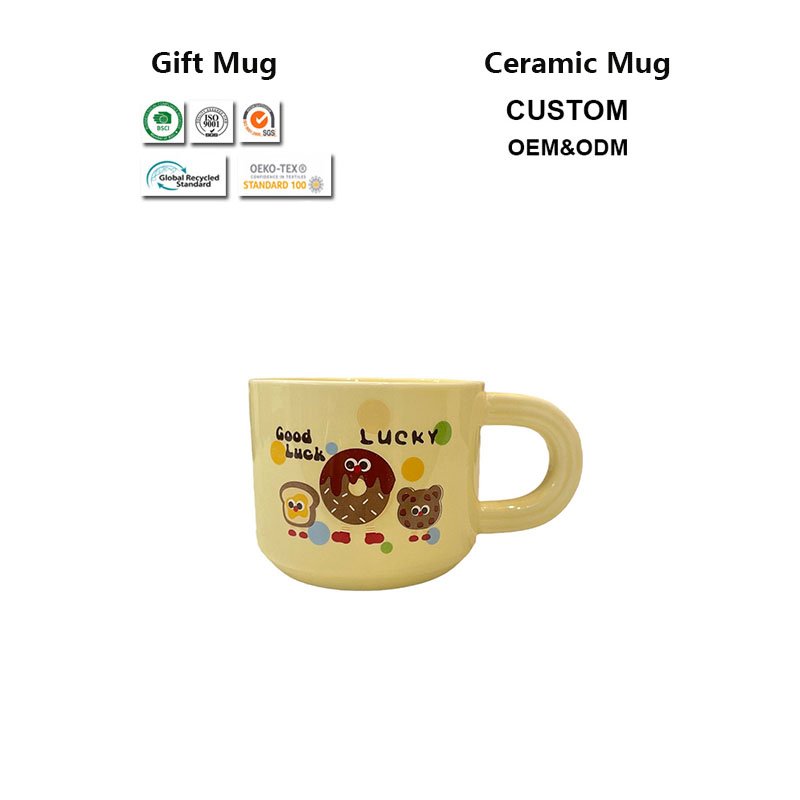




Breakage claims on printed promotional mugs rarely trace back to the print. In our line, wall thickness sits at 4–7 mm across the body and the rolled rim holds a tolerance band we measure at 3 points per unit. Those two numbers decide whether a mug survives a 1.2 m drop test and a 500-cycle dishwasher run. This page covers the wall and rim spec, not the artwork.
Why the Rim Edge Takes the First Impact
A mug dropped on a warehouse floor lands on the rim or the base corner. The rolled rim distributes that load, but only if the wall behind it is thick enough to resist ovalisation. Below 4 mm at the rim shoulder, we see chipping rates climb above 2% in transit testing. Between 5 and 7 mm, the rim holds shape and the chip rate stays under 0.5% across a 36-piece carton drop from 1.2 m.

Wall Thickness Bands and What Each One Costs
We run three wall bands on this line, and the band you pick changes weight, carton cube and freight cost per unit:
- 4–4.5 mm: lightest body, 11 oz lands near 290 g, suited to low-drop retail channels
- 5–6 mm: standard commercial band, 12 oz near 340 g, the default for promotional programs
- 6.5–7 mm: heavy band for hospitality and repeated industrial washing, 12 oz near 400 g
Each 1 mm of wall adds roughly 45–60 g to an 11 oz body and pushes carton gross weight up by 1.6–2.2 kg per 36-piece carton. That weight feeds directly into container loading plans.
Rim Tolerance: The Number We Hold the Line On
The rolled rim is measured for outer diameter, roundness and edge thickness. We hold roundness within 0.6 mm and edge thickness within 0.4 mm on the 5–6 mm band. A rim that runs oval by more than 1 mm will not seat flat on a saucer and will chip at the lip line during stacking. Every lot is sampled at 3 points per unit across 20 units before packing.
How Wall and Rim Interact With the Handle Joint
A wet mug at 60–70°C is carried by the handle alone, and the joint sees repeated load. The handle attaches to a wall zone that must be at least 5 mm thick to spread that load. We pull test to 8 kg minimum, three pulls per unit, and reject any unit where the wall at the joint measures under 4.8 mm. Thin wall plus a heavy handle is the combination that fails in the field.
Firing and Water Absorption Behind the Wall Spec
Stoneware fired at 1180–1220°C with water absorption below 3% gives the body enough density to hold the wall band through repeated washing. A body fired below 1160°C can absorb above 4% and the wall swells slightly, which shifts rim roundness after 200 wash cycles. We verify absorption on every lot before the wall measurement is signed off.
Customisation That Stays Inside the Wall Band
Handle opening runs 25–32 mm and base diameter can be set to an existing rack pitch before tooling. Colour matching follows a fired chip, not a screen value, and we approve that chip before a production run starts. Capacity spans 8–20 oz, with 11 oz and 12 oz as the standard commercial sizes. MOQ is 500 pcs per colour and capacity, or 1,000 pcs for Pantone matching.
Carton, Drop Test and Lot Records
Cartons ship at 36 or 48 pcs, 0.03–0.04 cbm, with the approved shade reference inside the flap so a warehouse can compare a delivery without opening a mug. Packing lists state carton dimensions and gross weight. Food contact reports for FDA and EU files issue per lot, and the approved wall and rim standard is held for 24 months for repeat runs. Lead time runs 25–32 days after sample approval.

Booking Slots Around the Wall Spec
Q4 slots on this line fill 6–8 weeks ahead. A November campaign needs confirmation by early September to stay inside the 25–32 day window. Mixed capacities load in one container by carton count, which avoids a separate glaze setup per colour and keeps the wall band consistent across the shipment.
As opções de tamanho e cor estão na caneca de cerâmica página da categoria, e as etapas de queima e esmaltação por trás desses números são descritas em o passo a passo do processo de fabricação.