







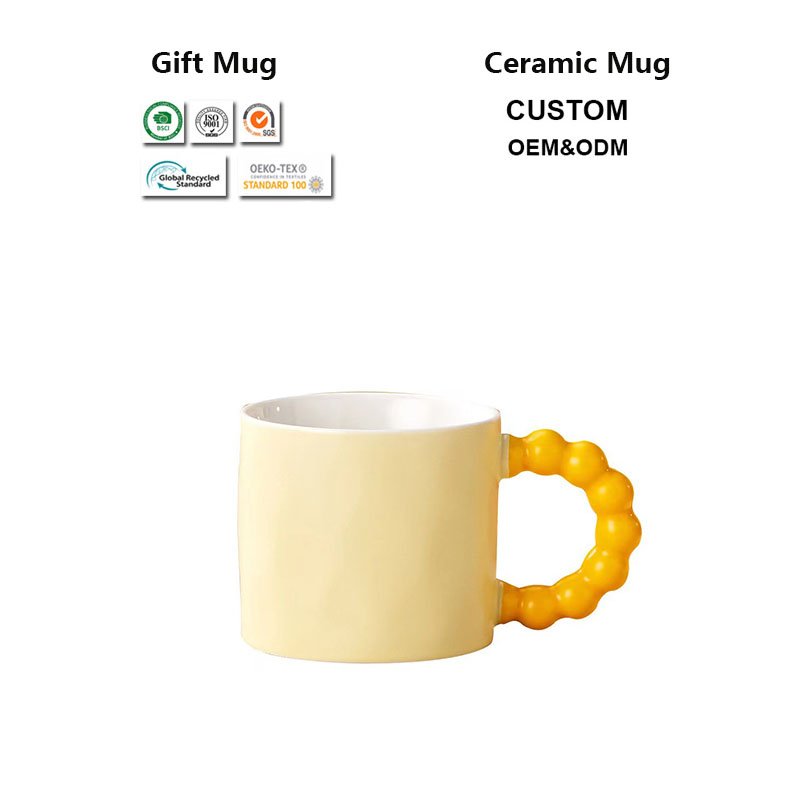



Stoneware mugs fire at 1180–1220 °C with water absorption below 3%, and the handle joint — not the body — is the first point to fail after repeated 60–70 °C wash cycles. This page covers what actually changes between a 500-piece trial order and a 5,000-piece production run: sampling rounds, tooling decisions, glaze setup, and lead time.
What a 500-Piece Order Actually Buys You
At 500 pieces per colour and capacity, you are buying a validated sample, not a scaled run. The MOQ sits at 500 pcs per colour and capacity; Pantone matching pushes the floor to 1,000 pcs because a custom glaze needs its own setup and a fired chip approved before production starts. Expect 2–3 sampling rounds: round 1 confirms profile and handle opening (25–32 mm), round 2 confirms the fired shade against your reference, round 3 is a signed-off pre-production sample. Each round adds roughly 7–10 days. At this volume, base diameter can still be adjusted to your existing rack pitch before tooling is cut, and wall thickness stays in the 4–7 mm body range with a rolled rim.

Sampling Rounds: Where the Schedule Slips
Most delays come from colour, not clay. A screen value and a fired standard are different things, so we approve a fired chip — a physical tile pulled from the kiln — before any run begins. If your team reviews on-screen only, budget one extra round. Handle pull testing runs to 8 kg minimum, three pulls per unit, and the report ships with the sample so your QC can compare it against the production lot. Capacity options run 8–20 oz, with 11 oz and 12 oz as the standard commercial sizes; at 500 pcs you can usually hold two capacities in one colour without a second glaze setup.
O que muda ao atingir 5.000 peças
At 5,000 pieces the economics move from sampling to setup amortisation. A dedicated glaze batch, a fixed kiln schedule, and a locked carton spec (36 or 48 pcs, 0.03–0.04 cbm) become worthwhile. Tooling for a custom base diameter or a non-standard handle opening is quoted once and spread across the run. Lead time settles at 25–32 days after sample approval, but the clock starts only when the fired chip is signed. Mixed capacities can load in one container by carton count, which avoids paying a separate glaze setup per colour — a real cost difference at this volume.
Carton Count, Container Loading and Q4 Slots
Packing is quoted with carton dimensions and gross weight so your forwarder can plan loading without re-measuring. Each carton carries the approved shade reference inside the flap, so a warehouse can compare a delivery without opening a mug. Production slots for Q4 fill 6–8 weeks ahead; a November promotion should be confirmed by early September. At 5,000 pieces, book the slot before the chip is approved, or you will wait for the next kiln window.
Cost and Lead-Time Comparison at a Glance
- 500 unidades: 2–3 sampling rounds, 7–10 days each; MOQ per colour and capacity; Pantone matching requires 1,000 pcs.
- 5.000 unidades: tooling amortised, fixed kiln schedule, 25–32 days after sample approval.
- Ambos: 8 kg minimum handle pull, three pulls per unit; water absorption below 3%.
- Cartons: 36 or 48 pcs, 0.03–0.04 cbm, shade reference inside the flap.

Documents You Receive With Each Lot
Every lot ships with a packing list stating carton dimensions and gross weight. For premium stoneware coffee mugs orders, food contact reports for FDA and EU files are issued per lot. The approved fired standard travels with the carton, so a repeat run compares against the same reference rather than a screen value. If you are moving from 500 to 5,000 pieces, ask for the tooling quote and the Q4 slot date in the same reply.
As opções de tamanho e cor estão na caneca de cerâmica página da categoria, e as etapas de queima e esmaltação por trás desses números são descritas em o passo a passo do processo de fabricação.