







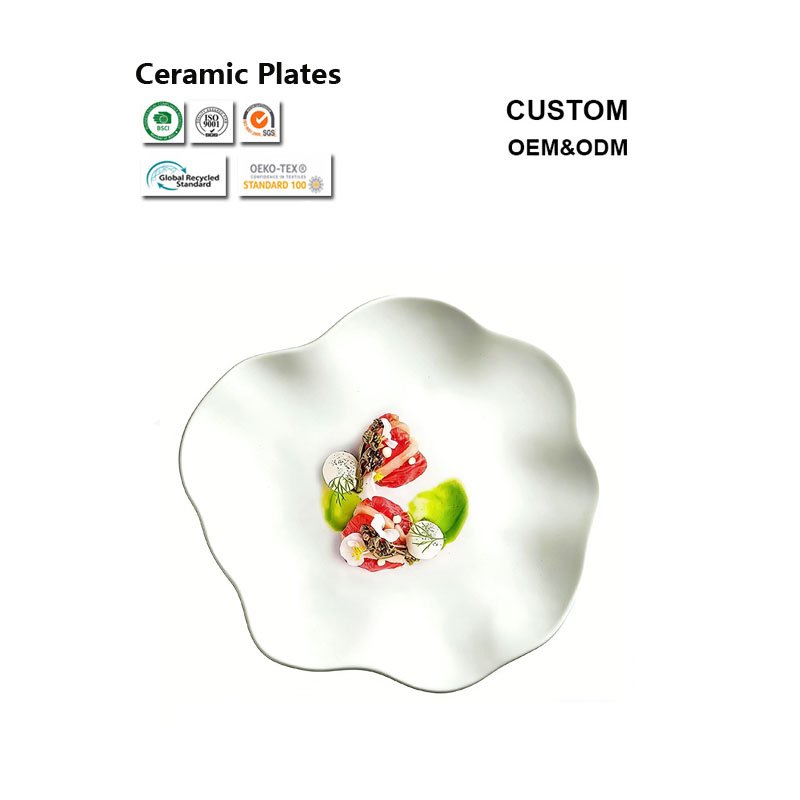
Two numbers decide whether a bulk plate order pays: 3% breakage across a container, and the dishwasher cycles a glaze survives before it dulls or chips. COMAIN fires 8″, 9″, 10.5″ and 11″ stoneware and porcelain plates at 1180–1250°C, then tests decoration and glaze against repeated commercial wash cycles. This page covers what happens to the surface, not the shape.
What 200 Dishwasher Cycles Do to a Decorated Rim
A commercial dish machine runs hotter and with stronger detergent than a domestic unit. We cycle plates through 200 washes at 65–70°C with alkaline detergent at pH 10.5–11, then inspect rim decoration under 3x magnification. Glaze loss, colour shift and edge chipping are recorded per batch. Plates that pass keep their decoration legible and their rim glaze intact; failures are traced back to firing curve or decoration layer thickness before the lot is released.

Why Glaze Thickness at the Rim Predicts Chipping
Chipping starts where glaze is thinnest, and on a pressed plate that is almost always the rim edge. We target 0.25–0.35 mm of glaze at the rim and check it on 5% of every lot with an eddy-current gauge. Below 0.20 mm, the body shows through after 60–80 wash cycles and cutlery contact takes chips out of the edge. Above 0.40 mm, the glaze can craze under thermal shock. The window between those two figures is what the firing curve is set to hold.
Decoration Applied Under Glaze vs On Top
Where the design sits in the glaze stack changes its wash life. Under-glaze decoration is fired beneath the glaze layer at 1180–1250°C and is effectively part of the body surface; it holds colour across 200+ cycles. On-glaze decoration fired at 780–850°C sits on top and wears faster at the rim, though it allows brighter colours. For restaurant chains running 8–12 wash cycles a day, we recommend under-glaze or reactive glaze for anything that meets a fork. Two-tone rims are quoted in both constructions.
Matte, Satin and Glossy Under Cutlery Contact
Matte plates mark from knife and fork edges. A hard matte fired at 1220°C shows less metal transfer than a soft matte fired at 1080°C, because the surface is denser and the cutlery slides rather than abrades. Where a matte look is required but marking is a complaint, a satin finish keeps the low-sheen appearance with better cutlery resistance. Glossy glaze marks least but shows scratches most. We supply test plates in all three finishes for a 30-day in-service trial before a bulk commitment.
Warpage and Weight Held Across a Wash Life
A plate that bows 2 mm lifts at the rim and stacks unevenly, and repeated washing accelerates that. We hold warpage under 1.5 mm, checked on a granite surface before packing. Weight drift matters too: a body 40 g lighter than the approved sample raises dish-room breakage. We weigh-check 5% of every lot against the approved sample. Nominal weights are 430 g (8″), 560 g (9″), 760 g (10.5″) and 840 g (11″).
Cartons, Drop Tests and the 2% Breakage Allowance
Each plate sits in an EPE or paper interleaf, 24 per 5-layer carton at 0.045 cbm and 20 kg gross, with corner protectors on the outer four. Cartons are drop tested at 1.2 m and stack tested 8-high for 72 hours before a lot ships. A 40HQ holds roughly 1,240 cartons. The contract breakage allowance is 2%, and anything above that is replaced. MOQ is 1,000 pcs per size and finish; lead time is 30–35 days after sample approval.

Sampling a Glaze Before You Commit 5,000 Pieces
Send the wash conditions your customers actually run — detergent type, water hardness, cycle temperature — and we will match a glaze and decoration construction to them. Sample plates ship with the firing curve and glaze thickness record attached, so the bulk run can be checked against the same numbers. Distributors running repeat orders of 5,000 pcs or more get the test data with the first container, not on request.
As opções de tamanho e cor estão na caneca de cerâmica página da categoria, e as etapas de queima e esmaltação por trás desses números são descritas em o passo a passo do processo de fabricação.