







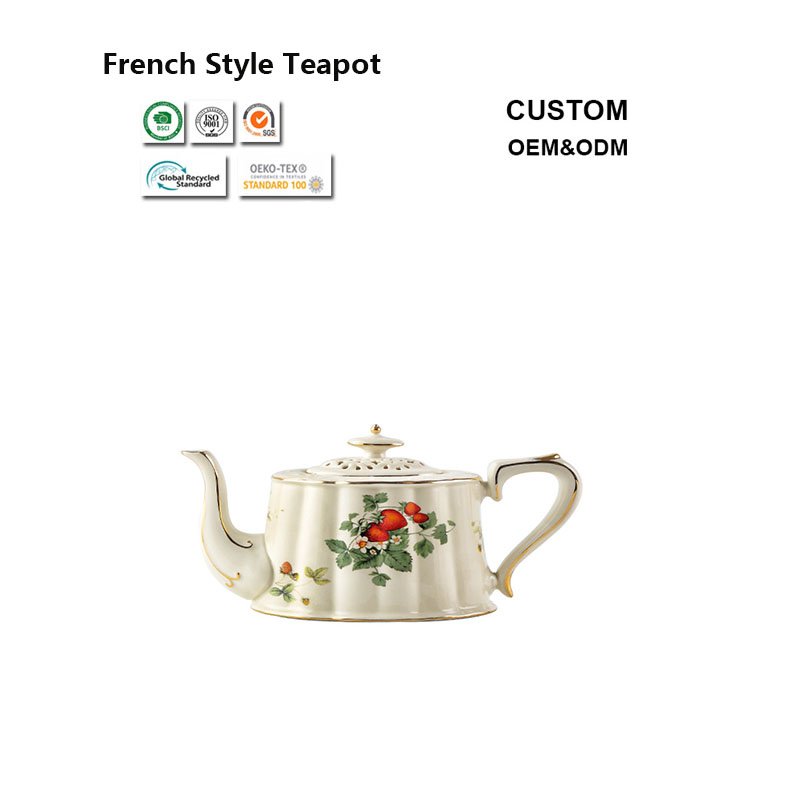


A 4.5 mm wall and a rim held to ±0.3 mm decide whether a branded hotel teapot survives its first tray drop. COMAIN runs this custom logo ceramic teapot line at 4.5–7 mm wall thickness, with travel moulds at the thick end and 180–300 ml bodies for two- or four-cup service.
Why the Rim Tolerance, Not the Glaze, Sets Breakage Rates
Chips start at the rim and the spout lip, where the section is thinnest and the load is concentrated. A rim ground to ±0.3 mm keeps the lid seat flat, so the lid does not rock and hammer the edge during washing and stacking. When rim flatness drifts past 0.5 mm, the lid gap opens and the first contact point takes the impact. Each pot is checked on the rim seat before glazing and again after firing, because a 1,200 °C firing moves the profile.

Wall Thickness Ranges and What Each One Trades
Table versions run 3–4 mm at the belly for lower weight; travel versions run 4.5–7 mm. The thicker wall absorbs impact energy across a larger section, so a 1.2 m drop inside the case does not translate into a hairline at the base. The cost is mass: a 7 mm body adds roughly 120–160 g over a 4 mm body at the same 250 ml capacity, and kiln time rises with section thickness. Wall variation across a single pot is held to 0.4 mm, measured at four points around the belly.
Rim Geometry: Grinding, Seating and Lid Fit
- Rim ground flat to ±0.3 mm; lid seat checked with a 0.1 mm feeler.
- Spout lip thickened to 2.2–2.6 mm to resist pour-side chipping.
- Lid underside relieved so the seat bears on the rim, not the inner shoulder.
- Foot ring flattened to 0.2 mm so the pot sits without rocking on the tray.
Glaze and Logo Under a Washing Cycle
The logo is fired under the glaze, so commercial washing attacks the glaze surface rather than the print. Celadon, matte grey and crackle are the three glaze families on this line. Crackle takes up tea pigment over time; that is stated as a characteristic at order, not handled as a claim. Glaze thickness runs 0.25–0.35 mm on the body, and the rim is left with a clean ground edge rather than a glaze bead, which is where chipping usually begins.
Case Fit as a Function of Wall Thickness
Case tooling follows the wall decision. A 7 mm travel body needs a 5 mm EVA hard shell with cut foam at 8–10 mm clearance per side; a 3.5 mm table body fits a 3 mm neoprene sleeve. Sets ship 12–20 per carton at 0.05–0.07 cbm, and carton markings state case colour and cup count so a distributor can split without opening. Drop testing runs at 1.2 m with the set inside its case.
Minimums, Colour Splits and Sample Retention
MOQ is 500 sets, with mixed colours from 150 sets per colour. A two-cup set ships about 18% cheaper per unit than a four-cup set, since cup count drives the price more than wall thickness does. Cups hold 40–50 ml. Approved samples are retained 24 months, so a repeat order keeps the same case fit, lid seal and rim tolerance. Lead time is 28–35 days after sample approval.

What the Buyer Receives With Each Lot
Every lot ships with a packing list giving carton dimensions and gross weight. Food contact reports for FDA and EU files are issued per lot. The approved standard is held 24 months, so shade, capacity and weight match the first shipment, and the wall and rim figures on the sample card remain the reference for every repeat run.
As opções de tamanho e cor estão na vaso de cerâmica página da categoria, e as etapas de queima e esmaltação por trás desses números são descritas em o passo a passo do processo de fabricação.
Essa mesma linha de tiro também abrange Conjunto de chá de viagem “Kung Fu Chinês” – Bule de cerâmica feito à mão com xícaras, utilizando o mesmo controle de espessura da parede e da composição do esmalte descrito acima.