







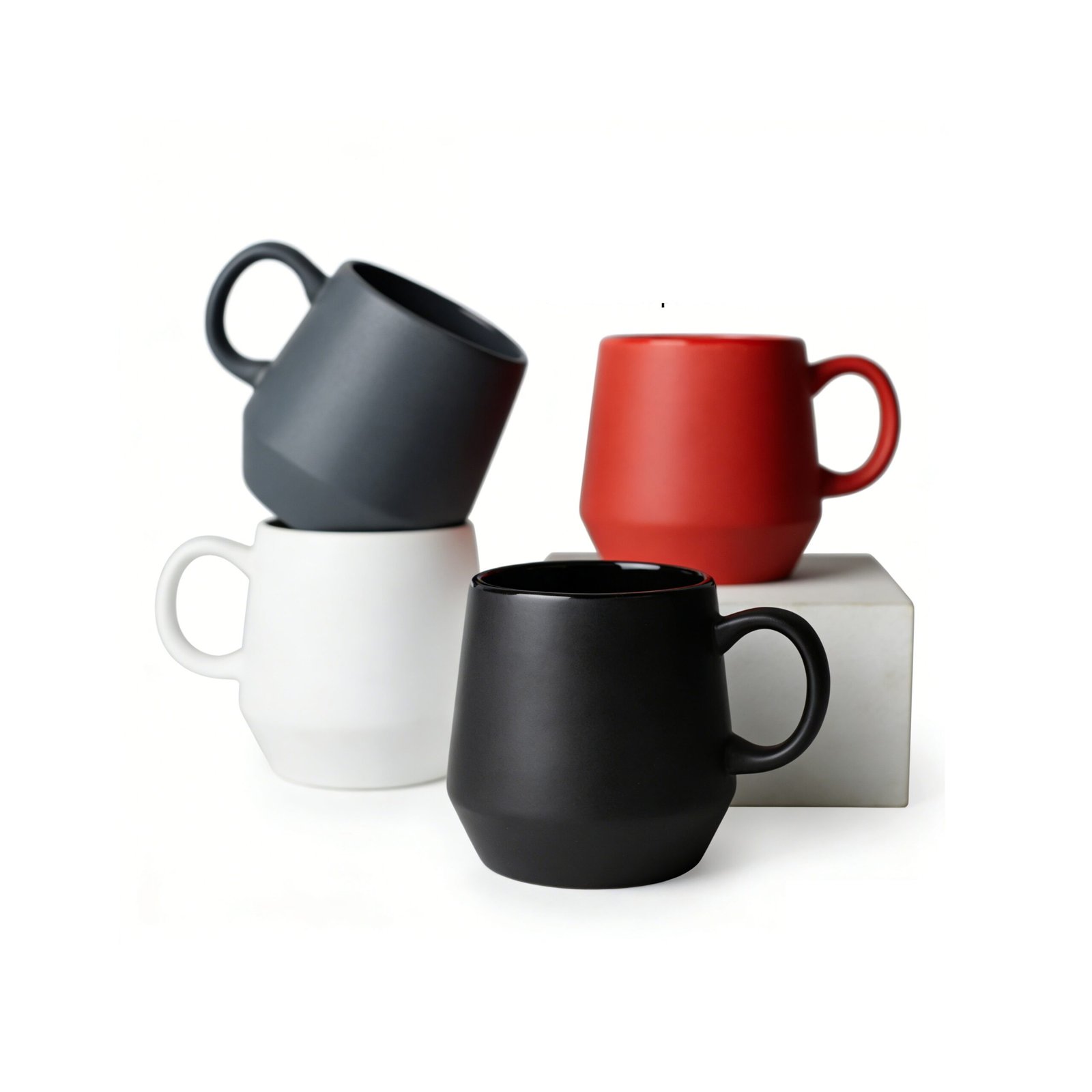



COMAIN molds the 11 oz sublimation mug to a wall thickness of 4.2 mm at the body and 3.6 mm at the base, with a rim tolerance held to ±0.25 mm. Across 15 production lines in Quanzhou, those two figures decide whether a carton survives a pallet drop or arrives at a retail DC with chipped rims. Buyers sourcing 20,000 units or more should read the numbers before the price.
Why rim thickness, not print quality, causes most breakage claims
A sublimation mug fails in transit for reasons set before decoration. A rim section that thins below 3.0 mm at the lip loses hoop strength and chips on the first impact; a body wall under 3.8 mm flexes during shrink-wrap and cracks along the handle join. Our forming line holds body wall at 4.2 mm ±0.15 mm and rim thickness at 3.6 mm ±0.2 mm, which keeps the lip above the 3.0 mm floor through firing shrinkage of roughly 12%.

Reading the rim tolerance figure: ±0.25 mm and what it absorbs
Rim tolerance is the vertical spread across the lip plane. At ±0.25 mm, a mug seats flat on a decorating mandrel and stacks without rocking in a 36-piece carton. Wider tolerance, common at ±0.5 mm, forces the wrapper to over-tension film, and that tension is what splits handles in a 1.2 m drop test. Buyers running automated sublimation presses should ask for the rim plane number, not the capacity.
How base thickness at 3.6 mm changes the drop result
The base carries the impact when a carton lands corner-first. At 3.6 mm, the foot ring absorbs energy before the body wall sees it. Below 3.0 mm, the base disc deforms and the glaze crazes outward from the foot. Our firing curve peaks at 1,180°C over a 9-hour cycle, which closes the body without pulling thickness out of the base.
Wall thickness across the 11 oz body: where the handle join sits
The handle is the second failure point. We form the join at 5.0 mm local thickness, tapering to the 4.2 mm body wall over a 14 mm blend. A sharp step at that transition concentrates stress, and a 250 ml fill at 95°C then a 20°C rinse will open a hairline crack within 40 cycles. The blend keeps thermal shock cycling inside the glaze, not the body.
Measuring wall and rim on incoming lots: a 30-piece check
- Pull 30 pieces per 5,000-unit lot from three carton positions.
- Measure body wall at 4 points, 90° apart, at 40 mm height.
- Measure rim thickness and rim plane with a dial indicator.
- Reject the lot if more than 2 pieces fall outside 4.2 mm ±0.15 mm body or ±0.25 mm rim plane.
- Log base thickness at the foot ring; flag anything under 3.3 mm.
This check takes about 25 minutes and catches the drift that shows up between kiln batches before it reaches a 20,000-unit order.
What the thickness spec means for your carton and freight math
A 4.2 mm wall at 11 oz gives a unit weight near 340 g. In a 36-piece carton with 5 mm dividers, that is roughly 12.6 kg gross, which keeps a 40HQ at about 1,150 cartons. Thinner walls cut 8 g per unit but raise the breakage rate; at 1.5% loss on 20,000 units, that is 300 mugs and the freight to replace them. The thickness spec is a freight decision as much as a durability one.

Setting the wall and rim callouts on your purchase order
Write the numbers into the PO: body wall 4.2 mm ±0.15 mm, rim thickness 3.6 mm ±0.2 mm, rim plane ±0.25 mm, base 3.6 mm minimum 3.3 mm. COMAIN confirms each against the mold drawing before the first firing and reports the 30-piece check with every lot shipped to Europe, North America, South America, and Southeast Asia. Send your target volume and carton format to comain@kmceramic.com for a quotation and samples.
As opções de tamanho e cor estão na caneca de cerâmica página da categoria, e as etapas de queima e esmaltação por trás desses números são descritas em o passo a passo do processo de fabricação.