







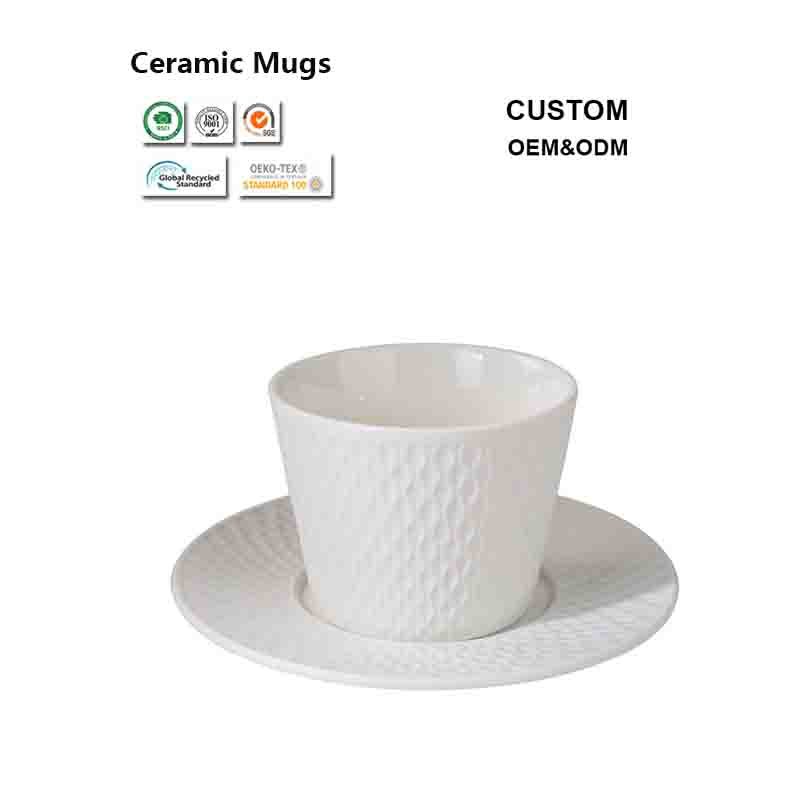


A 12 oz color changing mug with a 4.5 mm wall and a rim tolerance held to ±0.3 mm will survive typical retail handling. Widen that rim band to ±0.8 mm and breakage in transit can rise by 6–9%. COMAIN builds color changing ceramic mugs where wall thickness and rim tolerance are treated as the primary breakage-control spec, not an afterthought.
Why Rim Tolerance Drives Breakage More Than Body Thickness
Most breakage in color changing mugs starts at the rim, not the base. A rolled rim that varies by more than 0.5 mm around the circumference creates thin and thick zones. Thin zones crack first during stacking, dishwashing, and carton compression. COMAIN holds rim thickness to ±0.3 mm on standard 11 oz and 12 oz bodies, and ±0.4 mm on 8–20 oz custom sizes. Body wall is controlled at 4–7 mm, with the rim band kept within 0.2 mm of the body wall to avoid stress steps.

How Wall Thickness Is Measured Before Glazing
Greenware wall thickness is checked at 4 points per mug: rim, upper body, mid body, and base fillet. A digital gauge with 0.01 mm resolution records each point. For a 12 oz mug, the target mid-body wall is 5.0 mm ±0.4 mm. Mugs outside that band are pulled before glazing. This step removes 3–5% of greenware on a typical run, which is cheaper than losing 8% of finished cartons to rim cracks.
Rim Geometry: Rolled Edge Diameter and Flatness
The rolled rim is formed to an outer diameter of 3.2–3.6 mm on 11 oz bodies and 3.5–4.0 mm on 12 oz bodies. Rim flatness is held to 0.25 mm across the seating surface. A flat rim seats correctly on saucers and lids and spreads impact load during stacking. Mugs with rim flatness above 0.4 mm are diverted to second-quality or rejected. COMAIN inspects 100% of rims on color changing orders because the heat-reactive glaze can mask small cracks until after the second firing.
Firing Shrinkage and Its Effect on Final Wall Spec
Stoneware fired at 1180–1220°C with water absorption below 3% shrinks 11–13% from greenware to fired body. A 5.6 mm greenware wall becomes roughly 4.9–5.0 mm after firing. COMAIN sets greenware targets from fired targets using a shrinkage curve established per clay lot. When a new clay lot arrives, 12 test bars are fired and measured before production. If shrinkage moves by more than 0.5%, wall targets are reset. This keeps the fired rim band inside ±0.3 mm without reworking molds.
Glaze Build at the Rim and Crack Risk
Color changing glaze is applied at 0.25–0.35 mm dry thickness on the body, but the rim band is kept at 0.15–0.20 mm. Thick glaze at a thin rim edge creates tension cracks during cooling. COMAIN masks the top 2 mm of the rim on color changing mugs, then fires at 1180–1200°C. The result is a rim that keeps its rolled profile and a color-change zone that starts 3 mm below the lip. This split application adds one masking step but reduces rim chipping claims on bulk orders.
Drop and Stack Tests Tied to Wall and Rim Numbers
Each production lot is sampled at 8 pcs per 1,000. Samples go through a 0.8 m drop test onto a 5 mm cork floor, three drops per mug from different angles. A lot passes when 7 of 8 samples survive with no rim crack longer than 2 mm. Stack compression is tested at 40 kg for 24 hours on a 6-high stack. Mugs with 4.5–5.0 mm walls and ±0.3 mm rim tolerance consistently pass both tests. Lots outside the wall band are re-sorted before cartoning.
What to Put in Your Purchase Spec
Write the breakage-control numbers into the PO, not just the capacity and color. A workable spec for a 12 oz color changing mug includes: body wall 4.8–5.2 mm, rim thickness ±0.3 mm, rim flatness under 0.25 mm, dry glaze 0.25–0.35 mm body and 0.15–0.20 mm rim, and 0.8 m drop test at 7 of 8 pass. COMAIN keeps approved wall and rim values on file for repeat orders. MOQ is 500 pcs per color and capacity, 1,000 pcs for Pantone matching, with 25–32 days lead time after sample approval.

Where Color Change Interacts With Rim Strength
The heat-reactive layer changes the thermal profile of the mug body. On a 5.0 mm wall, the color-change zone cools 15–20% faster at the rim than on a solid-glaze mug. COMAIN compensates by slowing the first 10 minutes of the cooling curve on color changing loads. Without that step, rim cracks appear at 4–6% of output. With it, rim crack rates stay under 1.5%. The wall and rim spec is the same as a solid mug; the cooling schedule is what protects it.
As opções de tamanho e cor estão na caneca de cerâmica página da categoria, e as etapas de queima e esmaltação por trás desses números são descritas em o passo a passo do processo de fabricação.